


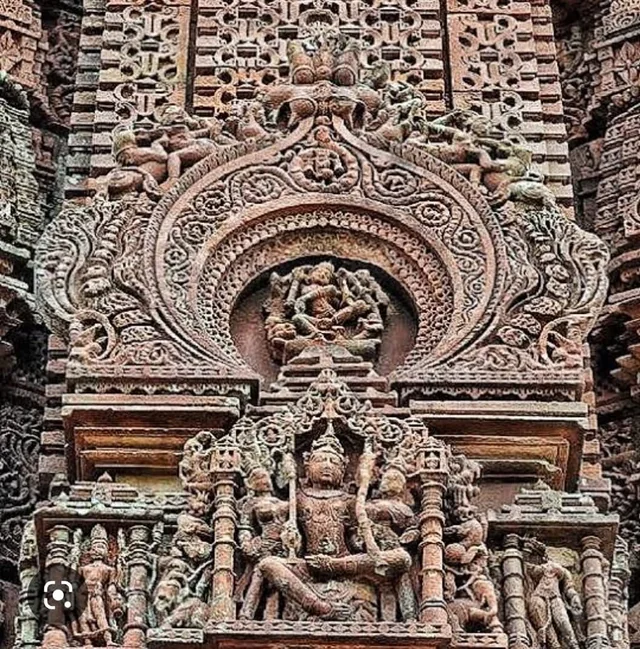
Hidden beneath millennia-old stone carvings and spiraling inscriptions, India’s ancient temples are now yielding secrets once thought lost: coded systems of astronomy, numerology, and royal symbolism that rewrite our understanding of sacred architecture. From the Shankhalipi “conch-script” spirals of Gupta-era U.P. temples to celestial patterns engineered into Chola monuments, researchers assert these holy sites functioned as cosmic blueprints and records of power, intentionally encoded across scripts, geometry, breath counts, and administrative edicts.
In This Article:
- Discovery & Cryptic Scripts
- Hidden Messages in Temple Walls
- Numerology & Numeral Innovations
- Temple Inscriptions as Historical Codes
- Interpretation: What These Codes Reveal
- Why This Matters
Discovery & Cryptic Scripts
Shankhalipi Inscriptions (4th–8th centuries CE)
Archaeologists uncovered spiral-shaped characters called Shankhalipi, or “conch-script,” on the stairs and pillars of a Gupta-era temple in Etah, Uttar Pradesh. The script, undeciphered in modern times, reads “Sri Mahendraditya,” a royal title of Kumaragupta I. These inscriptions are short and symbolic, likely names or marks of sanctity, found across central and western India and even Indonesia.
Hidden Messages in Temple Walls
Kailasa & Brihadeeswara: Geometric & Astronomical Codes
- At Brihadeeswara Temple in Thanjavur, scholars note intricate carvings that appear as Sri Yantra and Sudarshana Chakra patterns. Researchers believe these encode advanced knowledge of sacred geometry and astronomy, possibly serving as cosmic-wisdom diagrams rather than decorative art.
- Ellora’s Kailasa Temple exhibits pulsed solar alignments: on solstices, rays penetrate the sanctum, an architectural marvel showcasing astronomical precision embedded in stone.
Chidambaram Nataraja Temple: Breath Numbers and Cosmic Code
The layout of Chidambaram is astrophysically aligned with the Orion constellation and placed near Earth’s magnetic equator. The temple houses 21,600 gold tiles, a symbolic nod to average daily breath counts, and 72,000 iron nails, possibly representing cosmic nadis (energy channels). Together with nine doorways referencing the nine cosmic realms, the design constitutes a microcosmic map of life and the universe.
Numerology & Numeral Innovations
Use of “Zero” in Temple Carving
At Chaturbhuj Temple, Gwalior, a stone inscription contains the earliest known circular symbol for zero, carved into epigraphic records circa the medieval period. The inscription records garden dimensions and daily ritual yields, marking a regional milestone in numeral notation.
Temple Inscriptions as Historical Codes
Ootathur Sivan Temple: Re-dating Historical Records
In an ASI excavation at Trichy’s Ootathur village, the deciphering of 12 stone inscriptions pushed the temple’s origin back two centuries. Donor records dating back to Parantaka Chola I (937 AD) include gifts such as temple doors and cows for lighting and praise for Rajendra Chola I’s conquests of Ganges and Kedah (Malaysia).
Ranganathaswamy & Mahalingeswarar: Multi-lingual Administrative Codes
Ranganathaswamy Temple, Srirangam, preserves over 800 inscriptions spanning Tamil, Sanskrit, Kannada, Telugu, Marathi, and Oriya detailing donations, administration, diplomatic missions, and temple management from the 9th to 16th centuries. Similarly, Mahalingeswarar Temple in Thiruvidaimarudur documents detailed Chola-era grants (e.g., sheep donations for lamps) and devadasi practices, explicit cultural and administrative codes carved in stone.
Interpretation: What These Codes Reveal
- Shankhalipi remains one of the most enigmatic scripts—short, signature-like carvings with partly preserved royal names, yet still undeciphered.
- Sacred Geometry patterns (Sri Yantra, circle-triangle-square motifs) in Chola monuments suggest deep integration of cosmology and architecture.
- Numerical markers (zero symbol, breath counts & nadis) point to a philosophical tradition that transformed everyday structures into encoded metaphysical devices.
- Multilingual inscriptions functioned as administrative, ritualistic, and diplomatic codes, conveying precise historical data across linguistic boundaries.
Why This Matters:
These discoveries redefine temples not merely as places of worship but as living libraries of encoded science, governance, and spirituality. From undeciphered scripts to cosmic alignments, they reveal ancient India’s capacity for interdisciplinary knowledge, blending astronomy, numerology, linguistics, architecture, and statecraft into stone.
As modern archaeology continues decoding these temples, each carved symbol and block of text brings us closer to understanding ancient codes inscribed in cycles of breath, geometry, language, and devotion, encoded across centuries in Indian temples.
By – Sonali