


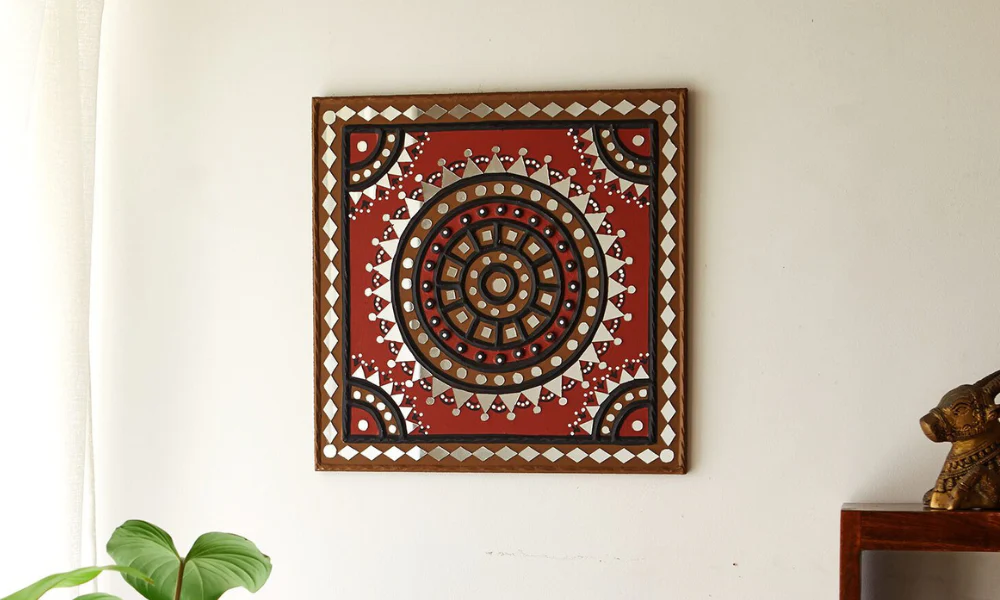
Lippan art, also known as mud-mirror or “mud mirror work,” has emerged from obscurity to find renewed popularity in galleries, homes, and cultural festivals across India and beyond. Primarily crafted in the arid landscapes of Kutch (Gujarat) and Sindh (Pakistan), this ancient form of interior and exterior wall decoration blends clay with cut mirrors to produce intricate, sparkling murals that reflect both light and heritage.
In This Article:
- Ancient Roots, Contemporary Resonance
- A Modern Revival
- Craft & Creative Process
- Symbolic Significance & Economic Impact
- Future Outlook: The living tradition of lippan art
Archaeologists and art historians trace Lippan art’s origins back 700 to 800 years to artisans of the Kumbhar/Kunbhar community, who transitioned their expertise from terracotta to wall-based forms of expression.
Ancient Roots, Contemporary Resonance
Historically, Lippan art has been practiced by women of the Rabari, Mutwa, Marwada, and Kumbhar communities. Working without formal tracing, they applied clay mixed with materials such as cow dung or millet husk directly onto walls and embellished them with mirrors and earth-toned pigments.
Each community brings a distinct visual vocabulary. For instance, the Mutwa community, originally from Sindh, often avoided depicting living creatures in their art, instead favoring geometric forms inspired by embroidery traditions. Their motifs include categories like Machi Kanado (fish-scale pattern), Pako, Katri, Bhori (flower based on native flora), Ikka or Ace, Chopad (dice pattern), sun motifs, and the circular Bindiya or Tika.
These symbols reflect not only aesthetics but also deeper cultural beliefs. Mirrors, for example, are considered auspicious and thought to ward off negative energies, while the clay layers help insulate homes from Kutch’s extreme weather conditions.
A Modern Revival
URBAN TAKEOVER & DECOR REVAMP
In recent years, Lippan art has swiftly transitioned from rural mud homes to urban interiors. Contemporary artists utilize MDF boards, ready-made clay compounds, acrylic paints, and decorative mirrors to replicate traditional patterns for sale in modern décor markets.
This aesthetic is increasingly favored in bohemian, rustic, and minimalist interior schemes. It also serves as an artisanal and customizable gift option for occasions like weddings, festivals, and housewarmings.
EDUCATIONAL & CULTURAL SPREAD
Schools like Apeejay School in Noida recently showcased Lippan art via inter-house competitions, encouraging students to engage with traditional crafts. Using natural clay, mirrors, and folk-inspired motifs, students produced spectacular artworks that celebrated teamwork, cultural heritage, and creative expression. Winning teams impressed judges with accuracy in mirror placement, symmetry, and textural detail.
Such initiatives help bridge generational gaps, ensuring Lippan art remains vibrant and relevant to new audiences while preserving its rural roots.
Craft & Creative Process
FROM CLAY TO CANVAS
Modern DIY kits make Lippan more accessible to amateurs and urban crafters: they typically include materials such as glue, clay compound, cut mirrors, and acrylic paint. These kits are often used on pre-cut wooden or MDF panels, allowing novices to explore the craft in a controlled setting.
To create original work, craftsmen still rely on hand-molded clay application over shiplap surfaces. After the clay dries, small geometric or floral mirrors are embedded within defined motifs. Traditional artists often skip pre-drawing and rely on memory and visual rhythm to construct patterns.
Symbolic Significance & Economic Impact
PRESERVING CULTURAL IDENTITY
Beyond decoration, Lippan art carries symbolic weight. In many Kandhar communities, mirrors represent protection and positivity. The motifs drawn, drawn from natural surroundings and portable embroidery patterns, reinforce links to place and identity.
CREATIVE ECONOMY BOOST
Lippan art products are gaining traction in gift shops and marketplaces such as Etsy, where mirror-decor wall hangings, nameplates, and mandala kits offer both rural livelihood opportunities and international appreciation.
The art has also featured in cultural festivals like the International Tribal Festival in Lucknow, where decorative Lippan items attracted large crowds. Artisans emphasized that many of these pieces were handmade from recycled materials and produced by talented women lacking mainstream platforms.
Future Outlook: The living tradition of lippan art
Lippan art is more than ornamentation; it’s a living tradition adapting to the 21st century. From mud walls of Kutch to contemporary décor studios and schools, the art form continues to evolve while anchoring itself in time-honored practices.
As interest and institutional support grow, Lippan art is poised to gain broader recognition, not merely as folklore, but as a dynamic expression of India’s cultural resilience and creative innovation.
In an age where craft meets commerce, Lippan art stands as a glittering testament to human artistry, collective memory, and the potential for heritage to illuminate modern life.
By – Sonali