


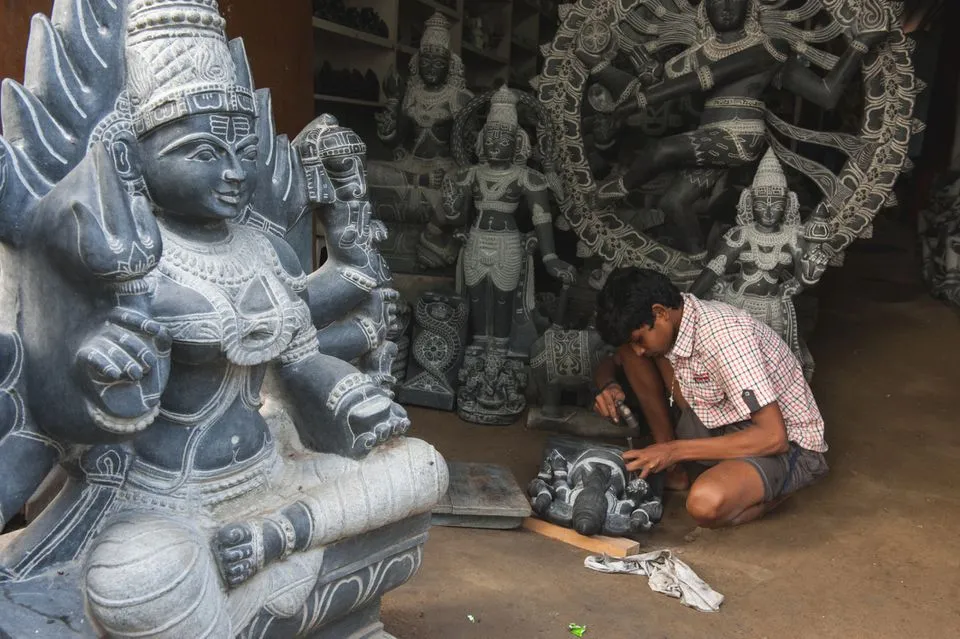
Soapstone carving, a centuries-old art form native to Tamil Nadu, stands as a silent yet powerful testament to India’s rich sculptural traditions. Known for its soft texture and smooth finish, soapstone—locally called Maakkal—has been used for intricate carvings that decorate temples, shrines, and homes across the state.
In This Article:
- Historical Roots and Religious Significance
- What Makes Soapstone Special?
- Where It Thrives Today
- Challenges Faced by Artisans
- Reviving the Craft with Modern Relevance
- A Cultural Identity in Stone
This delicate yet durable stone has been shaped by the skilled hands of traditional artisans into idols of deities, temple figurines, lamps, and decorative artifacts, preserving stories and spirituality within its folds.
Historical Roots and Religious Significance
- Soapstone carving in Tamil Nadu dates back to the Chola period (9th–13th century CE), when temple building and idol-making flourished.
- The stone was widely used to create murtis (idols) in temples like Brihadeeswarar Temple in Thanjavur and Gangaikonda Cholapuram, where many sculptures still retain their original luster.
- Traditionally, Shaivite and Vaishnavite deities were carved with great precision and ritual purity by Sthapathis (temple artisans).
What Makes Soapstone Special?
- Soapstone is a metamorphic rock composed mainly of talc, making it soft and easily workable when freshly quarried.
- Over time, it hardens on exposure to air, giving the carvings longevity and resilience.
- It offers a unique matte finish that enhances the spiritual aura of sculptures and is known to retain detailing even after decades of worship and exposure.
Where It Thrives Today
- The art is still practiced in and around Mamallapuram, Kanchipuram, and parts of Madurai and Vellore, where artisans continue this tradition with modern adaptations.
- Poompuhar Handicrafts, the Tamil Nadu government’s handicrafts development body, promotes and sells soapstone carvings nationally and internationally.
Challenges Faced by Artisans
Despite its historic importance, soapstone carving is facing a decline due to:
- Rising costs of raw materials
- Lack of younger artisans willing to learn the skill
- Competition from machine-made and synthetic replicas
- Limited marketing and global exposure
Reviving the Craft with Modern Relevance
To preserve this heritage:
- The Tamil Nadu government has included soapstone carving under crafts eligible for GI tagging and financial aid.
- Artisans are being trained to adapt their skills to modern decor trends, such as minimalistic idols, incense holders, and wall pieces.
- Tourism and e-commerce platforms are helping bridge artisans with a global audience.
A Cultural Identity in Stone
Soapstone carving is more than just a craft—it’s a spiritual and cultural expression that has defined Tamil Nadu’s artistic identity for centuries. As India continues to rediscover its traditional roots, reviving this sacred sculpting tradition could enrich not only temples and homes, but also the legacy of a civilization carved in stone.
By – Sonali