


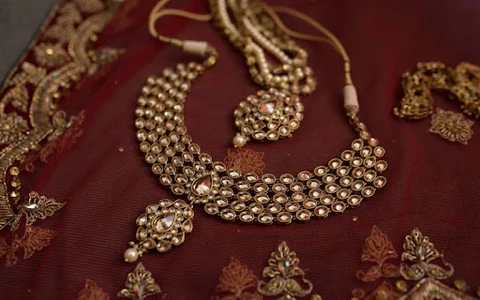
In the vibrant world of Indian jewellery, Kundan and Polki stand as glittering emblems of Rajasthan’s regal past. Known for their intricate artistry and historical roots, these traditional forms of ornamentation continue to dazzle brides, collectors, and connoisseurs alike, centuries after they first adorned royal necks and wrists.
In This Article:
- Historic Roots in Royalty
- What is Kundan?
- Understanding Polki: The Raw Diamond Art
- The Jadau Connection
- Modern Trends and Global Appeal
- Craftsmanship Still Lives in Rajasthan
- Investment Value and Authenticity
- A Symbol of Identity and Pride
Historic Roots in Royalty
Kundan and Polki jewellery trace their origin to the Mughal era, but it was in the princely states of Rajasthan, especially Jaipur, Udaipur, and Bikaner, where the craft truly flourished. The jewelry was often commissioned for queens and princesses, symbolizing wealth, power, and divine beauty. Even today, Jaipur remains a leading center of production for these unique pieces.
What is Kundan?
Kundan jewellery involves the setting of cut and polished gemstones into layers of extremely pure gold foil. The term “Kundan” itself refers to the refined gold used. The process is painstakingly intricate: first, a framework is created, filled with lac (natural resin), followed by setting the stones and then foiling it with thin strips of gold to hold everything in place.
Kundan work is prized for its front-facing sparkle and back-facing enamel work, known as Meenakari, a hallmark of Rajasthan craftsmanship.
Understanding Polki: The Raw Diamond Art
Unlike Kundan, Polki uses uncut, natural diamonds that have not been polished. These diamonds are placed using the same lac and gold foil method. Polki jewellery is heavier, more expensive, and often considered more luxurious than Kundan due to the value of the diamonds.
Polki pieces offer a rustic yet regal charm, often chosen for weddings and ceremonial wear. Unlike Western-style diamond jewellery that emphasizes brilliance, Polki focuses on grandeur and heritage.
The Jadau Connection
Both Kundan and Polki are made using the Jadau technique, which came to India with the Mughals. “Jadau” refers to the embedding process, not the stones themselves. It requires an ensemble of artisans: chiterias (designers), ghaarias (engravers), meenakars (enamelists), and kundansaaz (stone setters) working together in perfect harmony.
Modern Trends and Global Appeal
Kundan and Polki jewellery are no longer just heirlooms. Today, they have found a place on global red carpets and fashion runways. Designers from India and abroad have reinvented these styles to suit contemporary tastes, offering lightweight versions and fusion designs.
Celebrities like Priyanka Chopra, Sonam Kapoor, and Deepika Padukone have all adorned Kundan and Polki sets during weddings and public appearances, giving the traditional craft a global stage.
Craftsmanship Still Lives in Rajasthan
Despite growing competition and machine-made imitations, artisans in Jaipur and Bikaner continue to craft authentic Kundan and Polki jewelry. Many families have been involved in the trade for generations, often passing down their secrets from master to apprentice.
Brands like Amrapali, Gem Palace, and Sunita Shekhawat Jewels have upheld this heritage while adapting to changing market demands.
Investment Value and Authenticity
Due to their gold and diamond content, both Kundan and Polki are considered high-value investment options. However, experts advise buyers to be cautious and buy only from certified or reputable jewellers, as the market is full of imitations and glass-filled stones.
Polki, in particular, commands a premium and is usually accompanied by valuation certificates due to the use of raw diamonds.
A Symbol of Identity and Pride
Beyond ornamentation, Kundan and Polki jewellery are symbols of India’s artistic and cultural identity. They are not merely decorative pieces but carriers of history, crafted by hand, preserved by tradition, and cherished by generations.
By – Sonali