


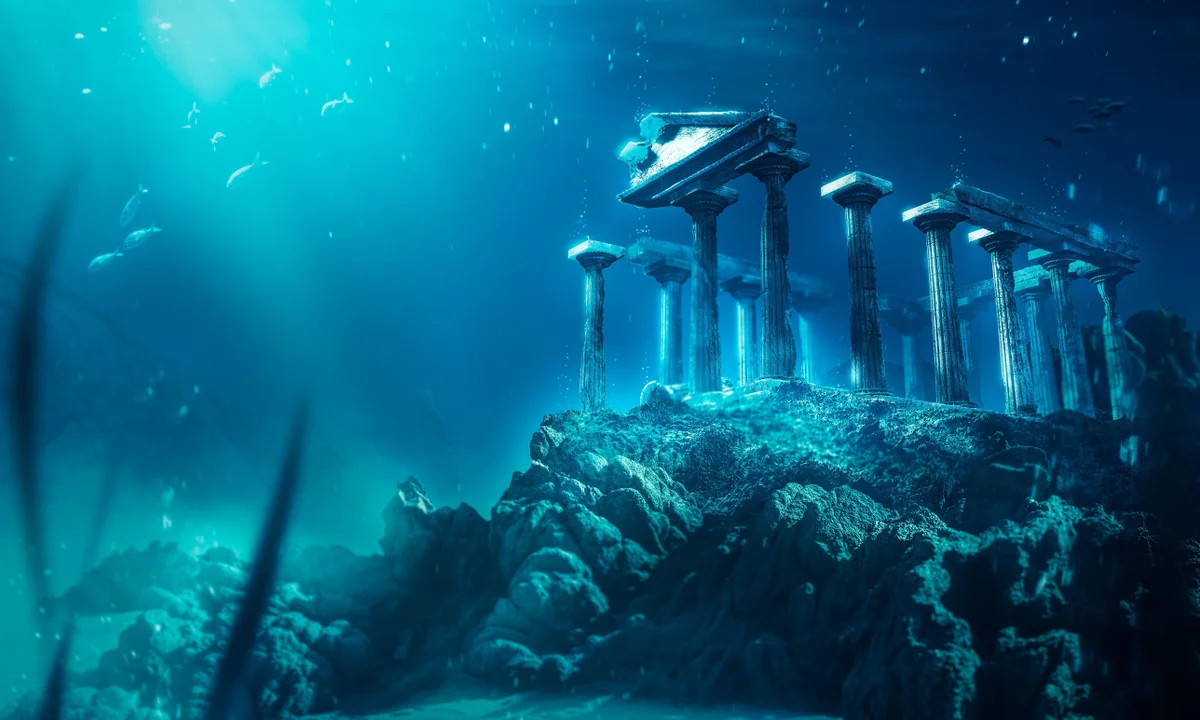
Atlantis has captivated imaginations for nearly 2,400 years. Since Plato’s original mention in his dialogues Timaeus and Critias, the legendary island, described as a utopian empire with grand architecture, advanced technologies, and a powerful military, has inspired countless speculations. But was it ever real? A few leading theories, each offering a different lens into the myth, continue to dominate the discourse.
In This Article:
The Mid-Atlantic Continent That Disappeared
Starting in the late 19th century, writer Ignatius Donnelly popularized the notion that Atlantis was a real, now-sunken continent located just beyond Gibraltar. He argued that remnants of an advanced civilization could have inspired Plato’s tale, before tectonic subsidence swallowed the landmass.
Modern evaluation: Science, particularly plate tectonics, has largely dismissed Donnelly’s vision of a shallow, sinking continent in the Atlantic. Yet believers point to Plato’s precise geographic cues as evidence that Atlantis once existed in this precise location.
Land of Mystery within the Bermuda Triangle
In the 1970s, Charles Berlitz fused Atlantis lore with his best-selling Bermuda Triangle mysteries. According to Berlitz, Atlantis lay near the Bahamas, its ruins now resting beneath the Triangle’s enigmatic waves. Reported underwater “roads” off Bimini added fuel to speculation.
Scientific view: Geologists assert the Bimini Road is simply a natural beach-rock formation. Though dramatic in appearance, no archaeological evidence supports its human origin.
Antarctica: The Forgotten Atlantis
Another theory, proposed by Charles Hapgood and endorsed with a foreword by Albert Einstein, suggests that 12,000 years ago, pole shifts displaced Antarctica from temperate latitudes. In a parallel timeline, an advanced civilization is said to have thrived there, only to be wiped out when ice engulfed the continent.
Scientific verdict: This “crust-shift” model preceded our modern grasp of plate tectonics and has since fallen into decline among geologists, who find no evidence of such cataclysmic displacement .
Black Sea Flood Memory
A more grounded theory sees Atlantis not as fiction but as poetic narration of a real event: the catastrophic flooding of the Black Sea around 5600 B.C. Geological evidence suggests the Mediterranean abruptly breached the Bosporus, turning a freshwater lake into a sea and displacing entire civilizations.
Cultural ripple effect: Survivors may have carried oral traditions of this catastrophe, which morphed into Plato’s Atlantis myth—blending historical memory with allegorical storytelling.
Atlantis as Plato’s Philosophical Allegory
Leading classical scholars maintain that Atlantis was fiction: Plato’s narrative device to illustrate his moral and political ideals. Without historical records, the story remains unique to Plato’s writings. Archaeological surveys and oceanic mapping have failed to locate any ruins that might correspond to Atlantis .
Expert consensus: The story’s consistency and memorability come from its allegorical heft. Critics point out there has never been a fully credible candidate site or archaeological confirmation.
A Trojan War Twist
Geoarchaeologist Eberhard Zangger offers another interpretation: Atlantis was an Egyptian retelling of Mycenaean power at Troy. He identifies potential harbor ruins and infrastructure in Greek landscapes that echo Plato’s maritime empire. Zangger argues the Atlantis story could be a veiled memory of Mycenaean-Greek conflicts.
Academic reception: While intriguing, the hypothesis remains speculative. It frames Atlantis less as a lost island and more as a symbolic allegory echoing real history.
Final Dispatch: Myth vs. Reality
Despite persistent fascination and six decades of theories, Atlantis remains elusive. Archaeologists, geologists, and historians widely dismiss literal interpretations, pointing to lack of physical evidence or geological plausibility.
So what is Atlantis today? A narrative mirror reflecting hope, fear, and the complexity of human memory. Whether reading Plato as a fictionalist or a historian, the tale endures: not as a buried empire, but as a haunting symbol of hubris and the fragility of civilization.
New Leads on an Old Legend
Atlantis has never been definitively found, but the search persists. From ancient coastlines to desert eyes and volcanic shores, researchers and explorers are drawn to pieces of land that fit fragments of Plato’s map. Whether archaeological breakthrough or allegory continues to fuel coverage. For now, Atlantis remains the Atlantic’s most enduring mystery, rooted in myth, yet compellingly real in its impact on our collective imagination.
By – Sonali