


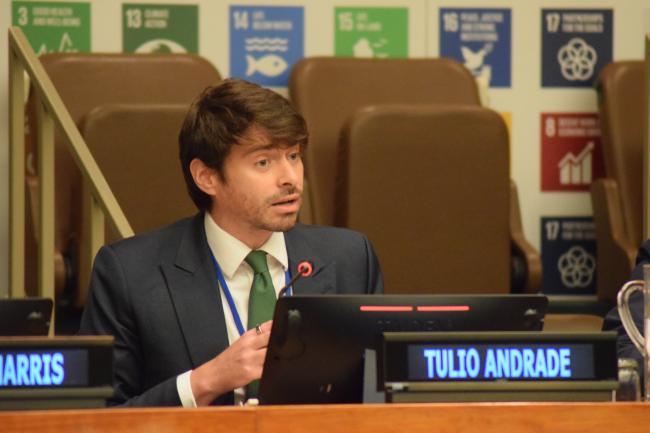
Mumbai, Feb 18 (PTI) Transitioning away from fossil fuels was not originally a standalone item on the formal COP30 agenda, and the lack of consensus led the conference presidency to launch a separate, voluntary process focused on both fossil fuel transition and ending deforestation, a UNFCCC official said.
In an interview with PTI Videos, Túlio Andrade, the Chief Strategy and Alignment Officer for the COP30 Presidency, said the consensus-based outcome document signalled a shift from a negotiation-centric phase to one focused on implementation.
This was something relatively new in climate multilateralism under the United Nations Framework Convention on Climate Change (UNFCCC) process, he added.
Andrade is known for his central role in facilitating negotiations for the Global Mutirão initiative at the UN Conference of the Parties (COP) in 2025.
The United Nations climate talks in Brazil in 2025 reached a subdued agreement that pledged more funding for countries to adapt to the wrath of extreme weather.
But the catch-all agreement did not include explicit details to phase out fossil fuels or strengthen countries’ inadequate emission cutting plans, which dozens of nations demanded.
“Although a coalition of approximately 80 countries sought a specific roadmap, the lack of consensus led the COP30 Presidency to launch a separate, voluntary process focused on both fossil fuel transition and ending deforestation. Beyond that, the ‘Mutirão’ text signalled a shift from a negotiation-centric phase to one focused on implementation,” Andrade said.
When asked about the expectations around fossil fuel language during COP30 and the subsequent criticism following its omission from the final text, the Andrade asserted that the ‘Mutirão’ text does not itself constitute binding international law, and that, each country must still submit its own national climate plans reflecting its economic realities, transition pathways, and sectoral conditions.
“The ‘Mutirão’ text operates within the framework of existing international commitments, and does not itself constitute binding international law. Each country must still submit its own national climate plans reflecting its economic realities, transition pathways, and sectoral conditions. However, the transition away from fossil fuels is inevitable,” Andrade told PTI.
He further noted that what COP30 represented was the expansion of climate discussions beyond negotiating rooms to all stakeholders, emphasising that the agenda now actively involves financial and economic sectors alongside society.
“Climate policy is no longer limited to declarations; it requires transformation on the ground. In this sense, a second tier of climate multilateralism has emerged, cantered on accelerating implementation,” Andrade said.
Reiterating that unlike formal international laws, implementation does not depend entirely on consensus at UN climate talks, the UNFCCC official said that such agreements advance through coalitions of countries and actors willing to lead and seize the opportunities created by the climate transition.
Reacting to the statement by Andrade, Director of Fossil Fuel Non-Proliferation Treaty initiative Alex Rafalowicz told PTI that multilateralism is essential for delivering climate action in an equitable way, and international agreements — like the proposed Fossil Fuel Treaty — provide essential pathways to ensure all nations contribute their fair share toward global goals.
He noted that such agreements may not involve all countries but it can still be a positive contribution to the international system, and advance the interests of developing and emerging economies.
“The global goal of limiting warming to 1.5 degree Celsius was agreed by consensus, and it’s the responsibility of all states to act to implement it, but their responsibilities are differentiated based on historic responsibility. Colombia and the Netherlands convening the first conference on the transition away from fossil fuels is an example of that,” Rafalowicz told PTI.
The first international conference on the just transition away from fossil fuels is slated to be held on April 28 and 29 in 2026, in the port city of Santa Marta, Colombia. PTI ABU PRK
Category: Breaking News
SEO Tags: #swadesi, #News, No consensus led to separate, voluntary process for fossil fuel transition: UNFCC official