


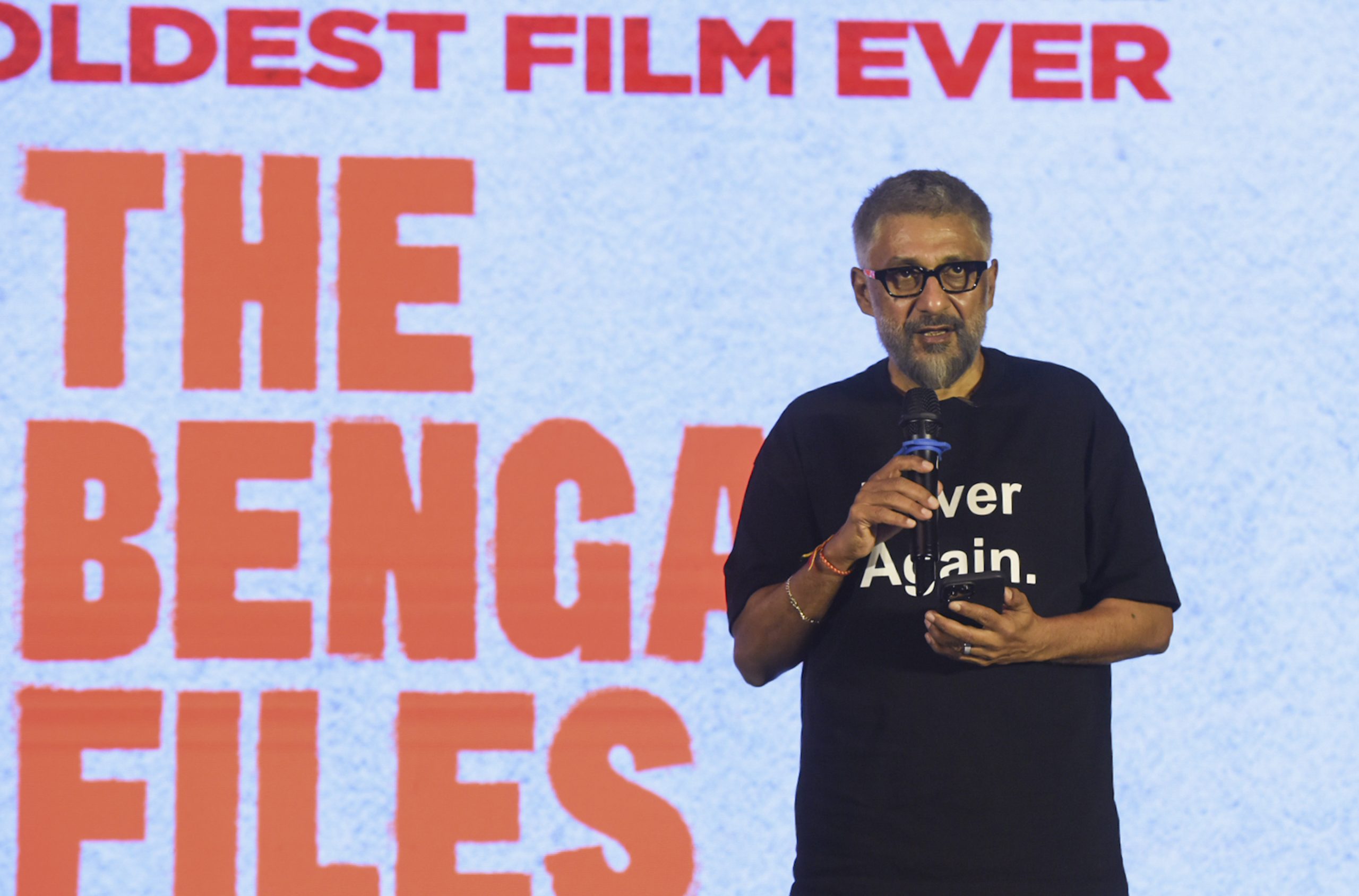
Recently, filmmaker Vivek Agnihotri opened up about his upcoming film The Bengal Files and described himself with striking sobriquets: both the “voice of Hindus” and a “psychiatrist for Indian society.” The film, set to release on September 5, delves into Bengal’s historical trauma while aiming to steer a healing cinematic narrative.
Healing Through Cinema
Agnihotri elaborated on his intention behind creating films like The Kashmir Files (2022) and now The Bengal Files. He stated that cinema, for him, serves as a tool of healing. “Acknowledgement of the trauma is the first step towards healing; you can ask any psychiatrist,” he asserted, adding that his film The Kashmir Files spurred this process for Kashmiri Pandits: “They say, ‘Your film has started our healing,’ which is true. I healed them.” On that basis, Agnihotri quipped, “I’m a filmmaker-psychiatrist (laughs).”
Self-Declared “Voice of Hindus”
On being called the “voice of Hindus,” Agnihotri didn’t hesitate. “Yeah, why not? Actually, I think I’m the voice of the entire Hindu civilisation,” he said, clarifying that his purpose isn’t to glorify; the aim is to both highlight the good and expose what went wrong. “What wrong has been done in civilisation or to civilisation, I want to talk about it.”
He likened his role to other filmmakers who represent particular communities through their art, such as filmmakers of LGBT or women’s issues, affirming that focusing on Hindu history through cinema is no different.
Why Hindu and Why Now?
Agnihotri acknowledged his limited engagement with histories beyond his own. “I cannot make films on Islamic or Christian history. I don’t understand them so well, so I’m incompetent,” he admitted, while expressing that given time and immersion, he’d be open to expanding his storytelling reach. “Let me go and live and study Islamic history, and I’ll make films on it,” he said.
He pointed to his earlier work, The Vaccine War (2023), a science-based film, as evidence of his range. Even though he is “not a scientist,” his research facilitated that project. Again, if given the opportunity, or even if terrorists in Kashmir wanted him to tell their story, Agnihotri said he’d be willing, should credible access be permitted.
The Bengal Files: Bengal’s “Untold History”
Agnihotri revealed that The Bengal Files addresses Bengal’s “untold history,” particularly the Great Calcutta Killings of 1946 (Direct Action Day) and the Noakhali riots. He implied these events were neglected in mainstream memory.
Though promotional plans faced setbacks—Kolkata’s trailer launch was cancelled last week—Agnihotri remains steadfast in his mission. He believes the film gives voice to those unaware of these traumatic chapters, aiming to start a broader societal reckoning.
The film features a formidable ensemble, including Anupam Kher, Mithun Chakraborty, Darshan Kumar, Simrat Kaur, Namashi Chakraborty, and Pallavi Joshi among others, and is scheduled for release on September 5, 2025.
Concluding Thoughts
Vivek Agnihotri’s latest statements underscore his perspective on the intersection of cinema, social conscience, and historical reflection. By positioning himself as a “psychiatrist” and self-appointed voice for a civilisation, he underscores his belief in cinema’s power to heal collective wounds. The Bengal Files is poised to add yet another chapter to his controversial yet impactful filmography, one that promises to challenge dominant narratives and revisit suppressed histories of Bengal.
By – Sonali