


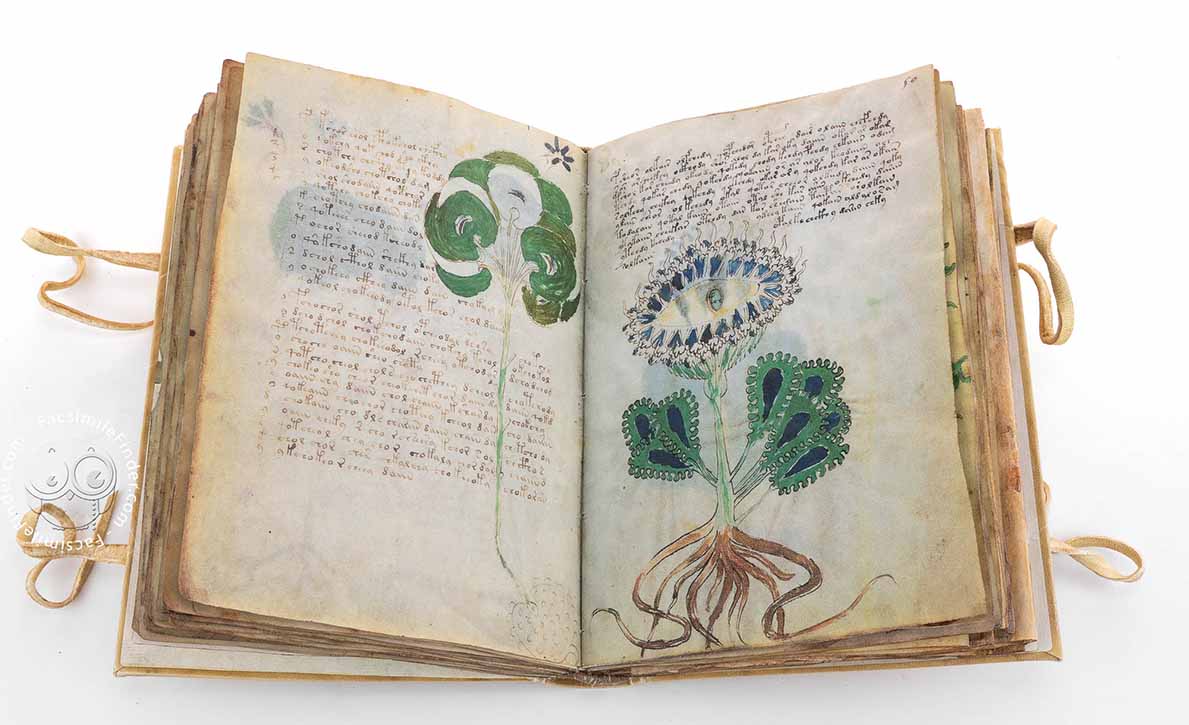
Originally carbon-dated to the early 15th century, scholars believe the Voynich Manuscript may have been produced in Renaissance-era Italy. Its script, known as “Voynichese” is entirely unique, and alongside pages of arcane text are fantastical illustrations of unknown plants, astrological charts, and nude figures bathing in green fluids.
In This Article:
After passing through various hands: 17th-century alchemist Georg Baresch in Prague, Holy Roman Emperor Rudolf II, Jesuit libraries in Rome, Polish antiquarian Wilfrid Voynich acquired it in 1912. In 1969, it was donated by book dealer Hans Peter Kraus to Yale University’s Beinecke Rare Book & Manuscript Library, where it remains under their stewardship today.
In-Depth Studies in Material Science
Forensic analysis has confirmed its early dating and mediums. Iron-gall ink, typical of antiquarian texts, covers vellum pages, while paints, such as azurite for blue and ochre for reds, suggest contemporary application in the 15th century. Chemical tests indicate water-based pigments and iron, potassium, calcium, even traces of copper, indicative of period materials, not modern fakes.
The Unbroken Textual Mystery
Despite involvement from top cryptographers: William and Elizebeth Friedman, John Tiltman, Brian Hauer, Greg Kondrak, the Voynich script defies all known languages and ciphers.
- Statistical patterns in the text (Zipfian distributions, word lengths, and repeated glyphs) align with real languages, not random gibberish.
- Hypotheses include verbose ciphers, constructed language, natural language in unknown dialect, or a purposeful hoax.
Recent Claims and Ongoing Scholarly Debate
In 2020, a German Egyptologist proposed a Hebrew connection; in 2025, an independent researcher introduced a “Dai Anchor Method,” suggesting a morphemic root for decoding plant names and rituals. However, no decipherment has yet achieved confirmed peer-reviewed acceptance.
Meanwhile, Yale linguistics professor Claire Bowern emphasizes the manuscript still offers insights via word-pattern analysis and paleography, even without translation.
Cultural Impact and Public Fascination
The Voynich Manuscript has inspired novels, films, video games, and music. It features in thriller fiction, alternative histories (echoing Roger Bacon), and avant-garde art—such as Serafini’s Codex Seraphinianus.
Yale has even published a full-color facsimile alongside scholarly essays to support public study and amateur research.
Why the Obsession Endures
What keeps the Voynich Manuscript on center stage?
- Historical authenticity — carbon dating and pigment analysis affirm its medieval origin.
- Unexplained text — polished handwriting and consistent structure suggest skilled authorship, not random scribbling.
- Mysterious imagery — botanical hybrids, naked figures in tubes, constellations: all defy straightforward interpretation.
As one Reddit commenter noted, it’s “a Rorschach test,” reflecting the interpretive biases of whoever studies it. Another emphasized, “It seems like this wasn’t just random gibberish, but either a skilled conman’s work or an actual cipher/language”.
What’s Next for the Manuscript?
- Yale continues digital access through high-resolution facsimiles to encourage crowdsourced analysis.
- Cryptographers and linguists use AI and information theory to parse patterns—like prime numbers, Fibonacci in pages, or structural glyph roles.
- Multi-disciplinary teams (chemists, art historians, botanists) examine it for clues linking to known medieval herbals, astrology, or ritual practice.
The Current Location
Yale University’s Beinecke Library (New Haven, Connecticut): The manuscript is physically secured, available to authorized researchers, and fully digitized for global viewing and study.
Final Word
More than 600 years after its creation, the Voynich Manuscript remains an enigma wrapped in vellum. It is neither solved hoax nor revealed cipher, but a perpetual magnet for curiosity—in libraries, labs, codebreakers’ desks, and online forums. Today, it stands both as a medieval artifact and a living puzzle, its future resting at the intersection of advancing technology and persistent human wonder.
By – Sonali