


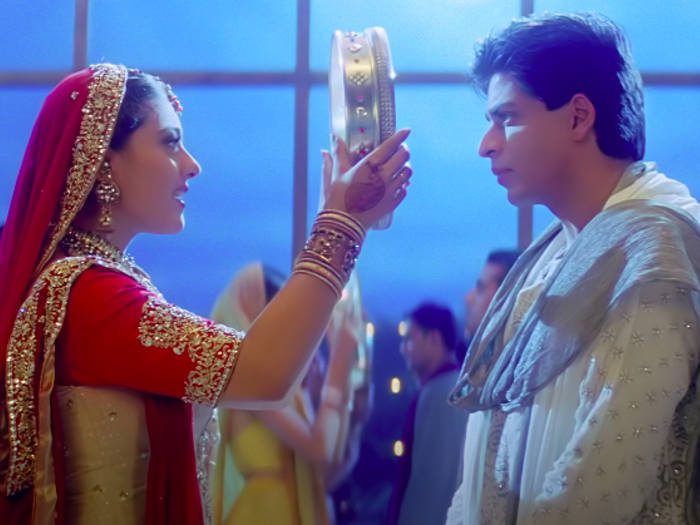
From candlelight rituals to family reunions under moonlight, Karwa Chauth has long held a special place on the silver screen. Over time, Bollywood has done more than merely include the fast; it has turned it into a storytelling device, a vehicle for romance, conflict, and spectacle. Here are how some of the most beloved films have used Karwa Chauth to deepen characters, colour relationships, and define emotions.
DDLJ: Love’s Ingenious Ruse
In Dilwale Dulhania Le Jayenge (1995), the festival becomes more than ritual; it’s part clever theatrics. Simran (Kajol) keeps Karwa Chauth and fakes illness, forcing Raj (Shah Rukh Khan) to break her fast by giving her water, all under the watchful eyes of family. This scene encapsulates youthful defiance, deep love, and personal agency, wrapped in simple drama.
Kabhi Khushi Kabhie Gham: Grandeur, Reunion and Tradition
In Kabhi Khushi Kabhie Gham (2001), Karwa Chauth enters the film during the vibrant song Bole Chudiyan Bole Kangna, bringing together family members, music, dance, traditional attire, and emotional connectiveness. The festival here isn’t just about the married woman’s fast—it’s a family affair with its joys and tensions, especially in the dynamics between mother-in-law, daughter-in-law, siblings, and lovers.
Hum Dil De Chuke Sanam: Love, Sacrifice, and Moonlit Moments
Sanjay Leela Bhansali’s Hum Dil De Chuke Sanam (1999) dramatises Karwa Chauth through lush visuals, emotional intensity, and romantic paradoxes. The song Chand Chhupa Badal Mein is woven into the ritual: the longing, the waiting for moonrise, and the tension between duty and desire. The festival becomes a mirror to Nandini’s inner conflict between tradition, love, and her heart’s wishes.
Baghban: Distance and Devotion
In Baghban (2003), the festival is used to underscore the emotional chasm between husband and wife separated by family. The scene where one fasts while the other, miles apart, breaks the fast via phone or symbolic gestures highlights how Karwa Chauth can be a conduit for expressing enduring love even in difficult circumstances. It is less about spectacle here and more about sincerity.
Ishq Vishk & Yes Boss: Youthful Romanticism
Aside from big family dramas, Karwa Chauth also figures in lighter love stories. In Ishq Vishk, the ritual comes before marriage, showing young lovers embracing the tradition even before formal commitments. Yes Boss too includes a poignant Karwa Chauth moment between the leads (Shah Rukh Khan and Juhi Chawla) that edges their relationship forward in a sweet, emotional way.
Cultural Reflection or Idealisation?
Kajol, who starred in both DDLJ and Kabhi Khushi Kabhie Gham, once observed that these films have “spoilt Karwa Chauth” for many people. She argued that what once was a simple, intimate fast has been elevated to something of a public spectacle, with elaborate clothes, decorations, and rituals made more cinematic than perhaps how many people experience it in real life.
More Than Just a Fast
Karwa Chauth in Bollywood is never just a fast. It is a canvas for longing, reunion, conflict, glamour, and sometimes confrontation with societal expectations, family dynamics, or between lovers. Whether in DDLJ’s quiet rooftop moment or K3G’s grand dance, the festival helps filmmakers create moments that resonate long after the credits roll.
By – Sonali